One veteran Ironman triathlete's venture into the ultramarathon realm where there are seemingly no limits to human endurance. Any triathlete who is interested in doing an ultramarathon should check here for tips and advice. For workouts leading to a successful finish at the Vermont 100 Mile Ultramarathon, you can find daily workouts at http://joegoldschedule.blogspot.com

Sunday, February 28, 2010

Part III. What are the types of periods used in the Periodization model?

In Part I I described the nature of cycles. In Part II I detailed why most endurance athletes utilize the Periodization model to get the competitive edge in racing. In this last segment I am going to describe to you the types of cycles most use and how it applies to the exercise/recovery balance.

Types of cycles in a triathlon season:

Macrocycle - entire season
Mesocycle - periods lasting 3-6 weeks each
Microcycle - weekly periods

Macrocycle

The first type of cycle is the macrocycle. The macro- prefix means “large” and that is exactly what it is. The macrocycle typically refers to an entire racing season. For most, this cycle will be about a year long, although in special cases it could be longer or shorter. Olympic athletes might have a macrocycle of 4 years as they train for optimal performance from one Olympiad to another.

In this example, I will draw the macrocycle as a 1 year season:


The green segment is your recovery period in the macrocycle, which is about 2-3 months for the typical training regimen. After many months of rigorous training and peaking for your big races, you need to give your body and mind a complete rest from the sport altogether, for a period of time (likely about 2 months) during the offseason. After their big race, I've seen a lot of people "burnt out" after months of training. They definitely need to shift gears to other pursuits for 2-3 months. Once the recovery is over, athletes like you should approach their next season (macrocycle) with renewed vigor and a completely healthy body.

Mesocycle

The next cycle is called the mesocycle. Each mesocycle varies from typically 4-8 weeks, depending on the training plan. Every macrocycle will contain a number of mesocycles. Each mesocycle has a distinct theme and intermediate goals. Mesocycles should fit nicely into your macrocycle. I now add the mesocycle to the sample above:


Again, there is a green section in each of the mesocycles. Again these are recovery periods that need to be built into these time periods, just as we did with the macrocycle. Notice how the 5th Mesocycle in the sample is all green compared to the others. This mesocycle falls completely under the macrocycle recovery period (the offseason). This means that every week in that Mesocycle is a recovery week.By placing easy recovery weeks properly with your heavy training weeks, you provide your body a partially sustained recovery in each mesocycle. This enables you to be “fired up” and healed enough to put the most of your energy into your harder weeks, thereby optimizing your training.

Microcycle

The last cycle that I will describe will be the microcycle. This is usually a week in length and is a day-by-day planning aid to get you to your immediate goals of your mesocycle and hopefully your long term goals defined by the macrocycle. Each mesocycle will contain a number of microcycles. In the sample chart, I will draw in 4 microcycles (weeks) into each mesocycle:


The resulting chart shows three hard weeks and an easier recovery week for each mesocycle.

Let's take a look at a sample microcycle:

And how does the training/recovery balance fit into this cycle? In day-to-day planning, you place 3-4 “key workouts” into your week and try to maximize them. Because a lot of effort is typically required of these “key workouts”, recovery is needed on certain days so that you are amply recovered for your next “key workout” in the week. For example, you pushed hard a 30 mile bike ride on Monday. The intensity of this workout warrants a necessary 24 hour recovery on Tuesday so that you are recovered and full of energy for that tough 10 mile run on Wednesday.

To put it all together, here is how a sample periodization plan looks like:

With these cycles in mind, next week's blog will put it all together by developing a sample training plan from the ground up.

Periodization Defined - Part II

Part I: What are cycles?
Part II: How is Periodization Related To Cycles?
Part III: What are the Periods Associated with Periodization?

How is Periodization Related To Cycles?

The first part of this article describes the basis for Periodization and why cycles occur in nature. In this second part, we describe Periodization and its relation to natural cycles.

So we established that cycles are needed to achieve balance and strength in nature. If that is true, then wouldn't it make sense to apply Periodization to your training? You do want to do well in your key races this year, right? And in endurance racing one needs to get strong in certain areas to achieve his/her goals, right? So it makes perfect sense to incorporate cycles into your training plan.

The main cycle that you will need to maintain is a balance between the two critical forces of training, exercise and recovery:

PERIODIZATION:    EXERCISE<------------------------->RECOVERY

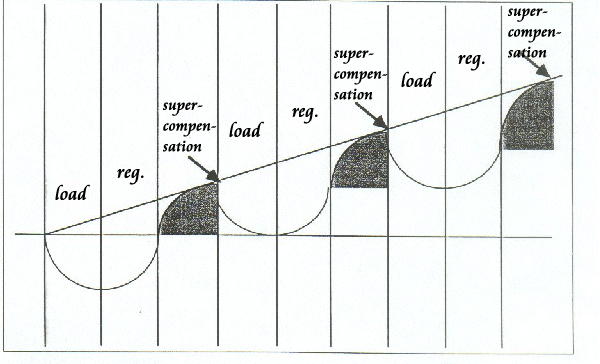
Exercise tends to break down the body when stresses are applied to it. Recovery is the ability of the body to heal itself to a point where it is much stronger. These two forces must stay in constant balance with one another in order to get stronger, faster, and healthier:


The chart above illustrates a sound Periodization training plan. Exercise puts a load or stress on the body and breaks it down. A good recovery will heal your body to a point better than before (called "supercompensation").

Unfortunately, many competitive athletes abuse exercise and neglect the recovery. This leads to an unbalanced condition where the body is broken down so much that leads to overtraining and injury. Ample recovery MUST be built in to the training plan for the body to rebuild itself stronger.

Periodization supplies the balance every sound training plan needs. As the name suggests, this balance is done through several periods (or cycles) of exercise and recovery. Planning workouts in this way allows the athlete to build in his/her rest and recovery in every period, and to allow the body to fully recover stronger from the stresses you apply through exercise. In the next segment, I will show you the types of periods or cycles that exist in this model.

Part 3 - What are the Cycles or Periods Associated With Periodization?

Saturday, February 27, 2010

Periodization Properly Defined - How To Correctly Design Your Triathlon Season


Part I ---------- Part II ---------- Part III

Most athletes have learned about the periodization approach to endurance training. But I have only seen few athletes really utilize them in the best way. This blog is to first define what periodization is, why it is the most important part of training, and how to properly plan your best season with it.

Periodization training involves periods, or cycles. Cycles are aplenty in nature. Can you name a few? Wikipedia surprisingly has an extensive list of natural cycles.

So the whole universe is run in cycles. Even if you just take a look around there are easy cycles to spot. There is the daily cycle where day follows night. There is a seasonal cycle, where we keep going through the natural progression of winter, spring, summer, and fall. You sleep to rejuvenate your body after an active day. Your computer monitor displays this blog by illuminating its pixels thousands of times per second (yes, there is a short amount of time in between where the your monitor is actually "off"). Cycles can even work over eons, as with the cooling and heating phases of the earth.

But why is everything in a cycle? Each and every one of these cycles is necessary to keep everything in a natural state of balance. Without them, we couldn't have balance, and imbalances would be very destructive to us and the environment.

Your body is just teeming with cycles, from biochemical to electrical. If you want to see a detailed list of your body's cycles, just pick up a biology or anatomy book; its very thickness tells you that there are many cycles running through your body right now. As stated before, you have a waking/sleeping cycle. Your body goes through numerous growth phases every day. Women have their menstrual cycle every 28 days. All the natural cycles that occur in your body provide the necessary balance needed to keep your body healthy and strong.

Cycles are constantly moving to keep nature, our environment, and our bodies in perfect balance. No one phase of the cycle can continue indefinitely; everything, especially people, need to shift to another phase of the cycle in order to keep harmonious with nature and to help keep ourselves strong.

The next segment will relate your Periodization training to cycles.

On to Part II

Sunday, January 24, 2010

Question of the Week - What reasons or inspirations drove you to do your first marathon?

This Week's Question - What reasons or inspirations drove you do to your first marathon?

Or first Ironman, or first Ultramarathon?

In this part of the year, where those from the Northern Hemisphere are contemplating their athletic goals for 2010, I am very interested in why you have started doing marathons in the first place.

I am also interested in all those who are set to do their first this year; what is currently driving you to do your race?

I will post your answers this Friday, along with my own reasons why I first did my first marathon, then why I did my first Ironman, then why I did my first ultramarathon.

I will also post on Friday some well known inspirations to ultra-endurance sports (for example, Team Hoyt) which is downright admirable to all of us.

So get your posts in either here or Tweet me your posts (coachjoegold) and I'll place them on this blog. If you wish to list yours but want to remain anonymous, I'll help you out there as well.

Happy Trails!

Friday, January 22, 2010

A Melodious Topic Part 2 - Your Motivational Running Songs

Thanks to all those on Twitter that responded to this week's question. What songs Motivate your Ultramarathon, marathon, and endurance training?

Here is a good list of answers from everyone. Great picks!!!

Foo Fighters - My Hero
Eye of the Tiger - Survivor
Learning to Fly - Pink Floyd
Dragonforce - Heroes of Our Time (take a listen to this piece, this is metal on steroids! :-)
Judas Priest - Heading Out To The Highway
Blur - Song Number 2 (a quirky song from a friend)
Propellerheads - Spybreak (From The Matrix, one of the greatest movies of all time, thanks FR)
Alice in Chains - Check My Brain (recent song, the guitar rifts are very unique)
Slipknot - Psychosocial (real heavy stuff, rattles my brain a bit after hearing it. :-)
Muse - Uprising (another new song, very catchy beat)
Ozzy Osbourne - I Don't Wanna Stop
Ozzy Osbourne - Crazy Train (My mention, after the above song by Ozzy was mentioned.

Again, thanks to all those who stepped forward.

Wednesday, January 20, 2010

The Melodious Topic of Ultra Running Songs - What are yours?

Humans are very musical creatures. If done right, the right song at the right time in any race, especially ultras can move mountains, or at least run over them easier.

For example, my first ultra, the 50 Mile Mountain Masochist in Virginia, I was having a real tough time climbing the toughest mountain in the course, Buck Mountain at Mile 27 of the race. I was really tanking and actually thinking about quitting the race when I overheard a series of Rocky Theme songs wafting through the trees from the aid station at the top of the mountain. I couldn't believe the transformation from a feeling of desperation to one of determination!. When I finally arrived at the summit at Buck Mountain, I was almost giddy and ready to tackle the rest of the course. From them on, I did not experience another low point and finished the race strong.

On the topic of motivational songs, I am opening the blog for what your favorite songs are. I will post yours on this blog. And, of course, if it motivates me, I'll see if I can add them to my list (yep, there is an ulterior motive here :-).

I have posted some of mine below. I am very responsive to metal and rock music, especially if it has a good beat.

Theme from Rocky (of course)
.
Van Halen - Right Now
The Specials - Pressure Drop
Yngwie Malmstein - On The Run Again
Testament - Return to Serenity (lyrics unrelated to running, but great beat)
Joe Satriani - If I Could Fly (I got a lot of other of his instrumentals too, he's a damn good guitarist)
Face To Face - Disconnected (nice fast beat)
Proclaimers - I'm Gonna Be 500 Miles (very quirky, but a BIG song when I tackled the Appalachian Trail - I carried this thing over to ultra running)

This is only part of my music list. You can post yours here or on Twitter. I'll compile the list and put them on this blog.

Thursday, December 31, 2009

Officially Registered for the VT 100 Mile Ultra!

Now, I'm committed to my New Year's Resolution...I am officially registered.

"Dear (Joe Gold),

Congratulations! You are now registered for Vermont 100. Please check the event's official website for updates: http://www.vermont100.com.

On behalf of the Vermont 100 Race Committee and Vermont Adaptive Ski and Sports we welcome you to the 22st annual Vermont 100 Mile Endurance Run! We look forward to seeing you in July! If you are interested in communicating with our pacer coordinator about signing up for a volunteer pacer please go to our website www.vermont100.com for the sheet which can be e-mailed or printed and sent in."

2010 here I come. Lets roll!